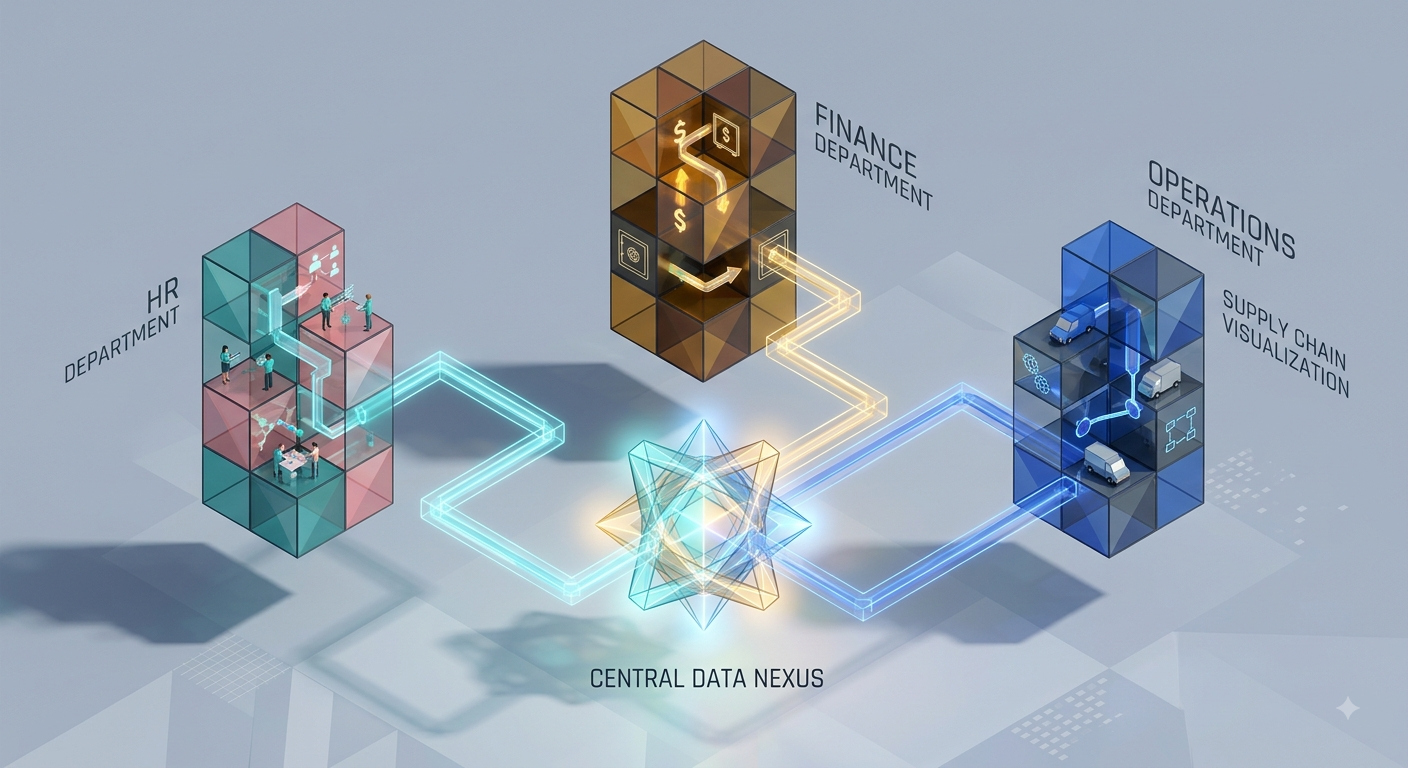
Over the past year, enterprise leadership across Hong Kong enthusiastically greenlit AI pilots within individual business units. Marketing teams deployed generative content engines, customer support integrated automated chatbots, and HR adopted algorithmic screening tools. On paper, each department celebrated isolated productivity gains. However, as organizations move into the second half of 2026, C-suite executives face an unexpected structural bottleneck: the "Siloed AI" trap. When AI systems are adopted in departmental vacuums without unified enterprise data architecture or cross-functional workflow integration, isolated efficiency gains generate massive operational friction at the handoff points between teams.
In complex corporate environments—from wealth management firms in Central to supply chain conglomerates in Kwai Tsing—business processes are inherently interconnected. When HR uses an isolated AI tool to fast-track candidate onboarding, but finance relies on legacy manual approval systems, the speed gain in recruitment creates an administrative bottleneck in payroll and compliance verification. Furthermore, when departmental AI tools operate on uncoordinated data models, executive leadership receives conflicting operational analytics. Instead of creating an agile, automated enterprise, unstructured AI adoption has built digital silos that duplicate software licensing costs, increase data security risks, and confuse employees who must manually bridge incompatible systems.
The Structural Risk: Localized Gains vs. Enterprise Bottlenecks
Allowing fragmented, department-level AI adoption to proceed without centralized governance creates severe organizational vulnerabilities:
- The Handoff Friction Point: Accelerating one segment of a workflow while leaving adjacent processes manual creates severe operational pileups at inter-departmental handoffs, negating overall time savings.
- Data Fragmentation and Compliance Blindspots: Departmental AI tools running on isolated data silos increase the risk of inconsistent data privacy enforcement, making compliance checks under PCPD regulations complex and error-prone.
- Tool Fatigue and Redundant Licensing: Without centralized IT and HR oversight, companies end up paying for overlapping software subscriptions across different business units, driving up technology overhead while complicating internal user training.
Strategic Blueprint: Transitioning to Integrated Enterprise Architecture
To eliminate operational friction and unlock genuine enterprise-wide productivity, Hong Kong HR leaders, CTOs, and business leads must establish unified AI governance.
- Map End-to-End Cross-Functional Workflows: Audit enterprise processes from start to finish rather than evaluating departmental tasks in isolation. Identify inter-departmental handoff points and prioritize automation projects that connect adjacent functions seamlessly.
- Establish a Centralized "AI & Automation Steering Committee": Form a joint committee comprising HR, IT, legal, and operational leads to evaluate, approve, and standardize corporate tech tools. Ensure all deployed platforms share common data protocols and compliance standards.
- Redesign Metrics Around End-to-End Speed and Quality: Shift performance indicators away from isolated departmental output metrics toward total process velocity, data accuracy, and cross-functional user satisfaction.
True digital transformation is not achieved by giving every department its own disconnected digital tool. Forward-thinking organizations recognize that real productivity gains happen when technology, data, and human workflows flow seamlessly across the entire enterprise.
References
- Gartner HR & IT Practice: Overcoming Departmental AI Silos in Modern Enterprises
- KPMG Hong Kong Employment & Tech Outlook: Integrating AI across Corporate Workflows
- Hong Kong Computer Society (HKCS): Enterprise Governance and Data Architecture Standards
- Harvard Business Review: Why Uncoordinated Automation Stalls Corporate Growth
- Office of the Privacy Commissioner for Personal Data (PCPD) Hong Kong: Guidance on Enterprise Data Governance