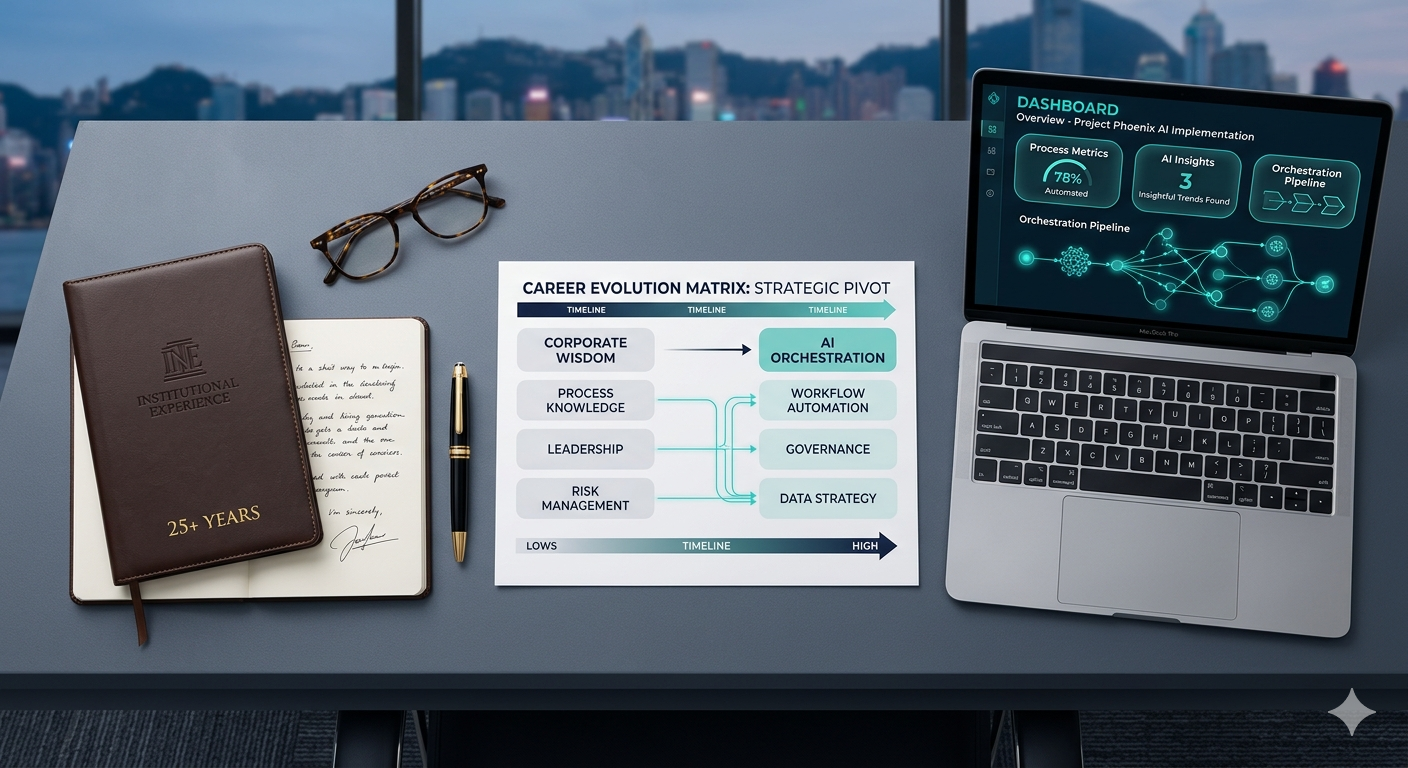
A quiet anxiety has taken root among established corporate professionals across Hong Kong’s core business districts. As enterprise automation accelerates and local companies restructure their operations around artificial intelligence platforms, many veteran managers feel an intense pressure to adapt. There is a common misconception that surviving the current technological shift requires going back to school for a computer science degree or mastering Python syntax from scratch.
The reality in the recruitment market is completely different. The true bottleneck facing Hong Kong enterprises is not a lack of coders; it is an acute shortage of seasoned professionals who understand how businesses actually make money, manage risk, and serve clients. For a mid-career professional, a successful pivot into the AI era is not about replacing your hard-earned corporate wisdom—it is about translating that experience into the language of modern technological orchestration.
The Myth of the Pure Technical Savior
Over the past year, numerous organizations across financial services, logistics, and retail have hurried to recruit pure technical specialists to implement advanced machine learning tools. However, many of these initiatives stalled. Without deep institutional context, pure technologists often build systems that are elegant in theory but fail to comply with complex local compliance rules, disrupt established client relationships, or overlook fundamental commercial realities.
This is exactly where the mid-career corporate professional holds a distinct competitive edge. Technology companies and traditional enterprises executing digital overhauls do not just need builders; they desperately require interpreters. They need leaders who can look at a predictive data model and immediately identify the operational risks, economic viability, and strategic implications for the APAC region.
The Translation Blueprint: Mapping Legacy Skills to Modern Value
To position yourself effectively to hiring managers and executive headhunters, you must systematically reframe your professional narrative. The goal is to show that your legacy corporate background is the exact foundation needed to maximize modern technical investments. Consider how your existing expertise converts directly into tech-era terminology:
- Operational Process Mapping to Workflow Automation: If you spent a decade managing a supply chain or managing an operations department, you possess a deep understanding of standard operating procedures. In the tech era, this skill translates directly into workflow architecture. You are the perfect candidate to design the logical structures, operational guardrails, and systemic rules that AI agents require to execute corporate tasks safely.
- Risk Management and Compliance to AI Governance: Managing complex multi-stakeholder corporate governance frameworks is one of the most transferable skills in the current landscape. As Hong Kong steps up regulatory oversight around data security, ethics, and cross-border information flows, your background in risk management positions you perfectly to lead AI compliance, vendor audit evaluations, and corporate implementation governance.
- Traditional Account Management to Technical Product Management: Successful product management is fundamentally about deeply understanding user pain points and coordinating cross-functional teams to deliver commercial solutions. Your long-term experience managing demanding enterprise clients, resolving commercial friction, and aligning multi-party stakeholders is precisely what technology platforms require to build commercially viable tools.
Tactical Steps to Execute Your Professional Transformation
Successfully transitioning your profile into the modern tech ecosystem requires a deliberate approach to positioning your expertise.
- Master Operational Orchestration Over Execution: Do not waste valuable time trying to become a junior-level developer. Instead, focus entirely on understanding what various AI tools can achieve, their operational costs, and their commercial limitations. Learn how to construct sophisticated prompts, structure retrieval-augmented generation inputs, and evaluate system accuracy. Your goal is to be the conductor of the orchestra, not the person playing every instrument.
- Build an Active, Verifiable Digital Footprint: The Hong Kong corporate market relies heavily on reputation and visibility. Use professional networking platforms like LinkedIn to share insightful analysis on how technology is changing your specific sector. Discussing the practical implementation challenges of modern software in real estate, legal, or finance demonstrates that you are actively thinking about industry evolution and positions you as a forward-thinking authority.
- Target the Crucial Implementation Layer: When applying for roles or networking with executive decision-makers, intentionally target the vital implementation layer. Avoid positions that demand deep engineering backgrounds. Instead, focus on vital bridge roles such as Business Systems Analyst, AI Product Owner, Digital Transformation Director, or Operational Excellence Manager. Position yourself as the executive who can step in on day one to ensure that multi-million dollar software investments yield actual, measurable commercial returns.
The eventual takeaway for long-standing professionals is empowering: the corporate experience you have cultivated over ten, fifteen, or twenty years is not an outdated liability—it is your greatest differentiator. By learning to reframe your deep operational insights, risk management background, and leadership capabilities through the lens of modern digital orchestration, you can easily position yourself as an indispensable asset in Hong Kong's rapidly evolving, technology-driven business ecosystem.
References
- KOS International: Technical Recruitment Shifts and Cross-Functional Talents. KOS International Insights
- KPMG China: Enterprise Digital Transformation Strategy and Implementation Barriers. KPMG China Market Insights