For too long, corporate conversations regarding employee mental health have been confined to the perimeter of human resources. The typical response to rising workplace stress, burnout, and anxiety has been reactive, often centering on peripheral benefits or temporary interventions—subsidized wellness apps, occasional "mental health days," or external Employee Assistance Programs (EAPs). While well-intentioned, these individual-focused solutions ultimately operate as corporate "app perks." They treat mental health as a personal issue to be managed by the employee, rather than an operational outcome heavily influenced by structural organizational factors.
Today, this paradigm is rapidly dissolving. Data from modern workplace intelligence and employee relations research,including analytics from specialized risk tracking firms like HR Acuity, reveals a disturbing operational reality: mental health challenges have now officially surpassed traditional disciplinary, performance, or grievance matters to become the single leading driver behind complex employee relations (ER) cases in major enterprises.
When untreated or unmanaged, these individual challenges escalate into severe organizational and financial risks,manifesting as significant spikes in voluntary turnover, dramatic losses in operational productivity due to absenteeism and presenteeism, and intensified exposure to workplace safety failures. Most critically, ignoring these structural factors creates substantial corporate governance and regulatory compliance liabilities, as global regulatory bodies and occupational safety standards increasingly incorporate psychosocial hazards alongside physical safety requirements.Executive boards and C-Suite leaders can no longer relegate mental health to the "perks" column. It has arrived at the core of boardroom risk management, demanding a shift from wellness-focused benefits to a comprehensive governance framework built on Psychosocial Risk Management.
The Rise of Psychosocial Hazard Identification
A functional Psychosocial Risk Management framework does not focus on individual employee resilience or diagnosing medical conditions. Instead, it applies a rigorous, analytical governance lens to identify, assess, control, and monitor the structural "hazards"—the psychosocial risks—embedded within company policy, job architecture, and operational safety standards. These hazards are the root causes of workplace distress, rather than the distress being the hazard itself.
Forward-thinking organizations must replace generic wellness strategies with systemic, data-driven audits designed to pinpoint these structural psychosocial risks. This requires moving beyond anecdotal evidence or engagement surveys to identify specific hazards within the organization’s DNA, such as:
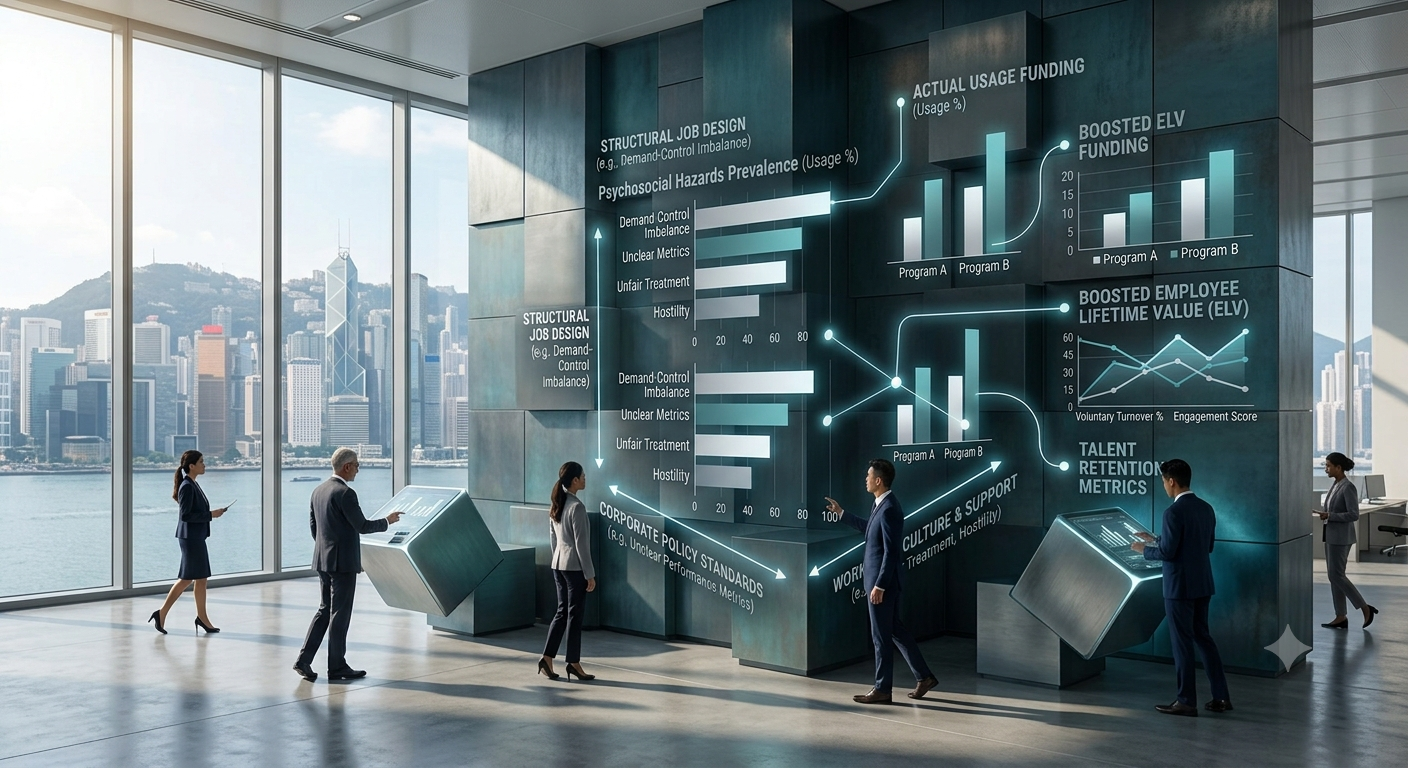
- Structural Job Design Hazards: Measuring systemic imbalances between unmanageable role demands (e.g.,chronic overwork, relentless time pressure, constant interruptions) and available employee control (e.g., lack of influence over decision-making, autonomy, or schedule flexibility).
- Workplace Culture Hazards: Identifying systemic issues regarding poor supervisor support, a failure to recognize or reward performance fairly, or the psychological risk exposure caused by hostile, competitive, or uncivil workplace interaction.
- Corporate Policy Mismatches: Auditing internal standards for performance metrics, career progression pathways,or remote work policies that, in their default design, inadvertently generate severe psychological distress or create profound work-life imbalances.
When these psychosocial hazards are identified and addressed, mental health transitions from an unpredictable cost center into a powerful driver of organizational durability. A structurally safe workplace where cognitive demands are balanced,autonomy is maximized, and supervisor support is institutionalized operates as the ultimate retention differentiator.
Maximizing Employee Lifetime Value and Organizational Durability
Treating mental health as a boardroom issue delivers a powerful return on investment. It tackles the massive, unseen costs of presenteeism and mental-health-related turnover that otherwise devastate corporate profitability. According to leading workforce strategy and total rewards firms like WTW (Willis Towers Watson), organizations that implement highly customizable, life-stage-responsive benefit programs alongside robust psychosocial risk governance experience a dramatic improvement in perceived corporate value and a significant reduction in voluntary resignation rates, especially among mid-career and senior professionals where replacement costs are highest.
By prioritizing Psychosocial Risk Governance, organizations achieve a state of cognitive optimization. Talent is not a static resource to be continuously consumed, burned out, and replaced; it is an asset that must be continuously optimized and protected. In an environment defined by rapid digital transformation and relentless commercial execution, the most resilient enterprises will not be those that offer the most extensive wellness app subscriptions. The competitive advantage belongs to the organizations that successfully engineering psychological safety directly into their structural job design,corporate policy, and long-term workforce architecture. Resilient design is not a perk; it is the ultimate foundation of modern organizational durability.
References
- HR Acuity Annual Employee Relations Benchmark Report and Risk Analytics
- WTW (Willis Towers Watson) State of Generations at Work and Total Rewards Strategy Analysis
- International Organization for Standardization (ISO) 45003: Occupational health and safety management — Psychological health and safety at work: Guidelines for managing psychosocial risks