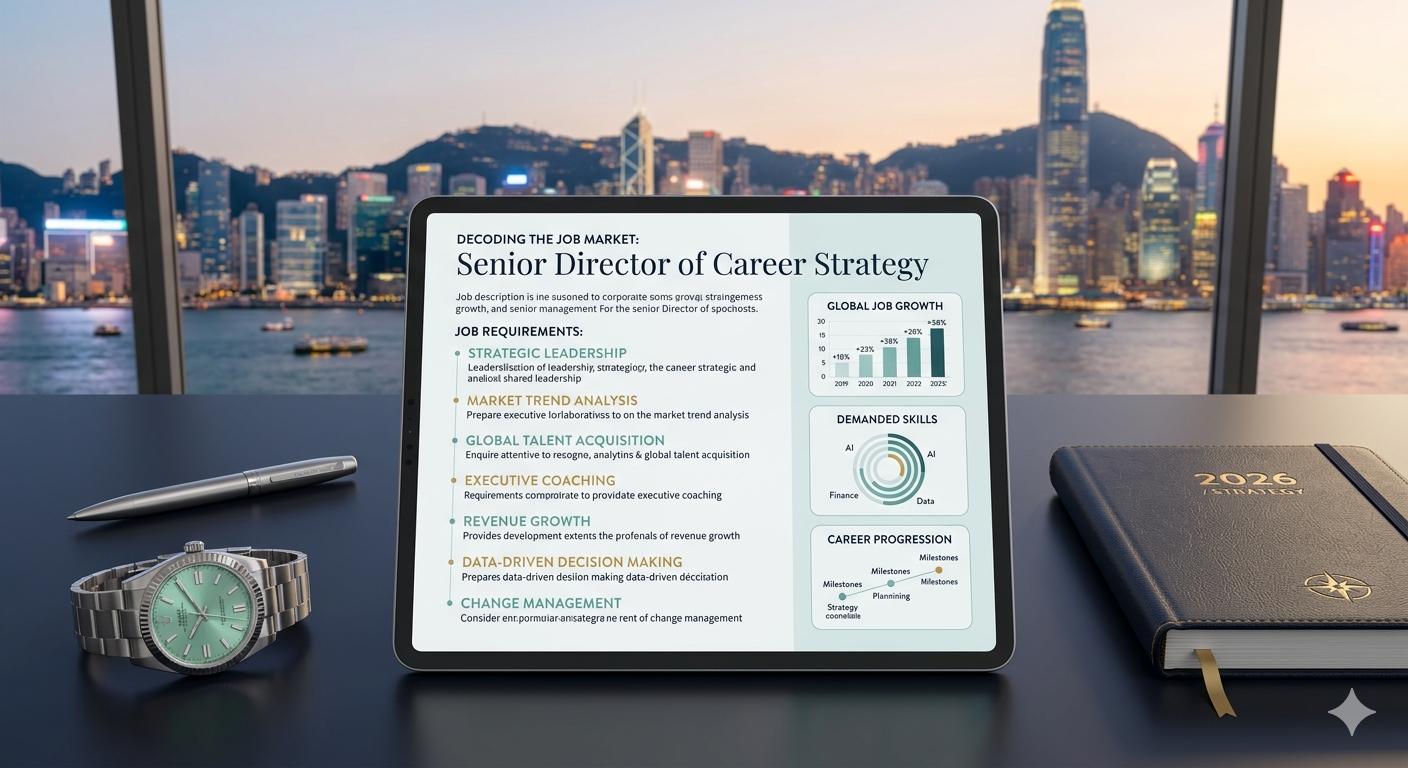
The modern job description is no longer a simple list of daily duties and required academic degrees. In Hong Kong’s highly sophisticated and competitive employment ecosystem, the language used in a job posting serves as a carefully calibrated corporate instrument. It reflects an organization's internal culture, immediate business pressures, systemic anxieties, and strategic direction.
For job seekers navigating a market defined by extreme selectivity, and for HR leaders seeking to audit their own talent attraction strategies, learning to read between the lines of a job description is a critical skill. What a company chooses to emphasize—or completely omit—tells a vivid story about what life inside that business truly looks like.
1. The Core Performance Signals
When a job description prominently features phrases such as "thrives in an ambiguous environment," "comfortable operating with imperfect information," or "demonstrates immense resilience under commercial pressure," it signals a corporate framework undergoing rapid structural transition. In many instances, this indicates that the business is actively navigating a regional realignment, a technical system migration, or a significant operational restructuring. The employer is not looking for a passive caretaker to execute an established, predictable playbook. They are actively seeking a highly adaptable professional who can build order out of chaos without requiring constant managerial hand-holding.
2. The Multi-Dimensional Value Trap
The rise of portfolio-style value has altered how roles are scoped across major commercial hubs. When a posting pairs highly technical mandates with heavy commercial responsibilities—for instance, requiring a candidate to master deep software integration while simultaneously managing client-facing business development and APAC strategy—the organization is signaling role consolidation. This language indicates that the business is deliberately merging two historically distinct cost centers into a single high-utility position. Candidates reading these descriptions must recognize that the employer is willing to pay a premium, but will expect cross-functional delivery across multiple corporate boundaries from day one.
3. Cultivating Career Durability
To build true career durability in the current landscape, professionals must align their resumes with the unwritten needs embedded within these descriptions. Organizations are hyper-focused on risk insulation and immediate value generation. When a job post emphasizes regulatory compliance, data privacy, or AI application, it means the business is exposed to fast-moving market constraints.
Understanding these hidden corporate drivers allows job seekers to transform their application narratives. Instead of merely listing past titles and linear promotions, successful applicants structure their profiles around measurable outcomes, showing exactly how they navigated past organizational transitions, preserved professional reputation under stress, and upskilled their teams to meet evolving demands.
For human resource leaders at Me2Works, auditing job descriptions to ensure they are transparent, equitable, and realistic is equally vital. In a market where top-tier specialized talent adopts a cautious, wait-and-see approach to changing careers, job descriptions that lean too heavily on intimidating corporate jargon can inadvertently alienate the very experts a company is desperate to attract. Clarity, authenticity, and a clear commitment to continuous learning are the ultimate tools for bridging the talent mismatch.
- Deciphering Common Job Description Buzzwords:
- "Fast-paced environment with a flat structure" — Often indicates a lean team where individuals must wear multiple operational hats and take immediate, independent ownership of projects without a robust administrative support network.
- "Strong stakeholder management across matrixed networks" — Signals that success in the role relies heavily on internal diplomacy, negotiating competing department priorities, and influencing senior executives who may hold conflicting agendas.
- "A tech-savvy professional with an eye for continuous optimization" — Points directly to an immediate expectation that the incoming hire will help automate legacy manual workflows and integrate AI tools to drive down operational overhead.