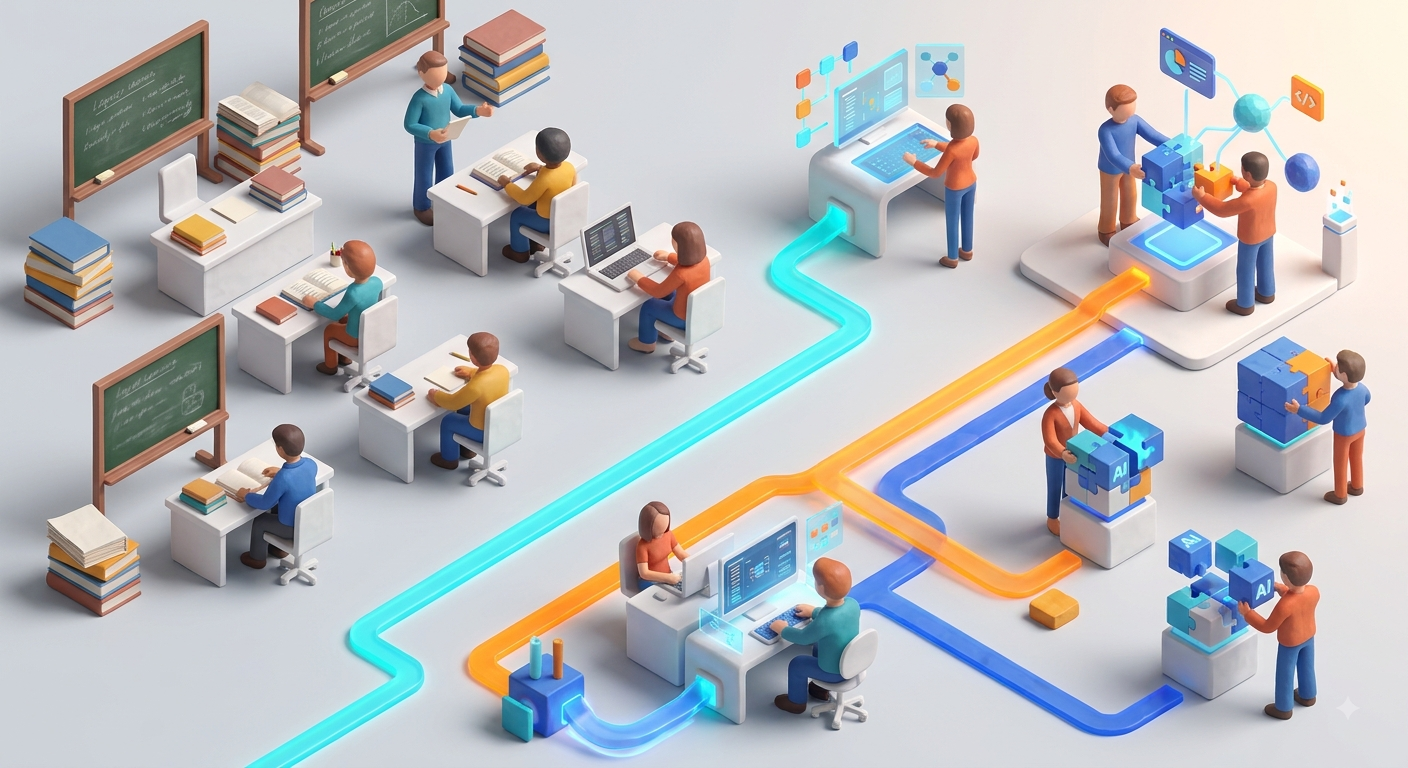
Your executive committee recently greenlit a substantial budget for corporate learning and development (L&D), enrolling cross-functional teams across your Hong Kong operations into standardized AI literacy workshops and prompt engineering courses. On paper, compliance rates look fantastic—modules are completed, certificates are logged, and attendance is at an all-time high. Yet, six months into implementation, internal operational audits reveal a stark reality: actual workflow automation remains stagnant, and your most innovative teams are quietly abandoning official L&D tools in favor of unapproved, self-customized AI workflows. The uncomfortable truth facing enterprise leadership is that traditional top-down training programs are too slow, too generic, and too theoretical for the rapid shift toward autonomous AI agents.
Across Hong Kong’s financial services, logistics, and tech sectors, the gap between corporate L&D content and real-world application is widening. Conventional L&D frameworks treat AI upskilling as a static subject to be memorized via video lectures and multiple-choice quizzes. However, in an ecosystem driven by agentic workflows—where AI systems independently execute multi-step tasks, audit code, and analyze financial models—learning cannot happen in a vacuum. When formal corporate training fails to address job-specific friction, high-performing employees perform "quiet re-skilling": secretly adopting personal tools, experimenting with unauthorized scripts, and building ad-hoc automated pipelines. This creates a dual risk for enterprises: a massive waste of official L&D spend and a growing shadow IT infrastructure that exposes sensitive corporate data to compliance breaches.
The Operational Gap: Static Courses vs. Agentic Reality
Relying on legacy L&D models to handle fast-evolving technologies creates systemic vulnerabilities across the enterprise:
- The Certificate Trap: Completion rates offer a false sense of security. Employees learn basic syntax or prompt templates in a controlled setting, but struggle to apply these tools to legacy databases, complex regulatory frameworks, or cross-departmental handoffs.
- Shadow IT & Compliance Exposure: When official enterprise tools are too restrictive or poorly integrated, frustrated talent turns to consumer AI platforms. Uploading proprietary client data or unvetted code into non-compliant environments creates major data privacy and regulatory risks.
- Skill Polarization: Without practical, embedded guidance, a gap opens between a small group of self-taught power users and a majority of employees who feel overwhelmed by AI integration, fracturing team productivity and morale.
Strategic Reframing: Moving from Static Modules to Embedded Sandbox Upskilling
To build genuine digital capability while maintaining strict data governance, Hong Kong HR leaders and CTOs must replace classroom-style L&D with hands-on, contextual learning environments.
- Shift from Generic Courses to Job-Specific "AI Sandboxes": Build secure, internal sandbox environments where employees can experiment with enterprise-approved AI agents using anonymized company data. Learning should happen through real-world problem solving rather than isolated video tutorials.
- Establish "Prompt-Ops" & Peer Champions: Identify and reward the informal power users already driving quiet re-skilling within your teams. Formalize their role as digital transformation champions who build customized, department-specific AI workflows and mentor their peers.
- Align Upskilling with Workflow Redesign: Treat AI training not as an HR checklist item, but as an operational overhaul. Redefine job descriptions and KPIs to explicitly reflect time saved, automation quality, and process improvements gained through AI adoption.
Future-proof organizations recognize that digital transformation isn't achieved by pushing static courseware—it happens by empowering teams with safe tools, practical application, and a culture that bridges technical capability with business execution.
References
- Gartner HR Practice: Overcoming the L&D Capability Gap in Enterprise AI Adoption
- Harvard Business Review: Why Corporate Training Programs Fail to Deliver Tech ROI
- Hong Kong Computer Society (HKCS): Enterprise Upskilling and Shadow IT Mitigation Standards
- MIT Sloan Management Review: Integrating Agentic AI into Daily Enterprise Workflows
- McKinsey & Company: Building the AI-Enabled Workforce of the Future