
The structural composition of the Hong Kong workforce is facing a rapid transformation. According to data from the mid-2026 Employment Outlook, an unprecedented 24% of local enterprises have now integrated and widely deployed Artificial Intelligence systems within their primary operations. This is a staggering 300% surge compared to early 2025 metrics.
Simultaneously, traditional hiring metrics reveal a deeply cautious corporate environment: only 19% of organizations plan an expansion of overall headcount, heavily prioritizing specialized sales and direct revenue-generating roles.
This environment has triggered a trend known as "job-hugging"—where employees adopt a defensive "wait-and-see" strategy, clinging to current positions for perceived stability. However, in an ecosystem where AI adoption is accelerating at this scale, standing still is the highest-risk strategy available.
The Danger of Job-Hugging in an Automating Market
For middle management and corporate specialists in Hong Kong, delaying career progression out of a desire for safety is a miscalculation. When companies automate backend tasks, roles that rely heavily on manual coordination, data entry, or repetitive administrative reporting are consolidated.
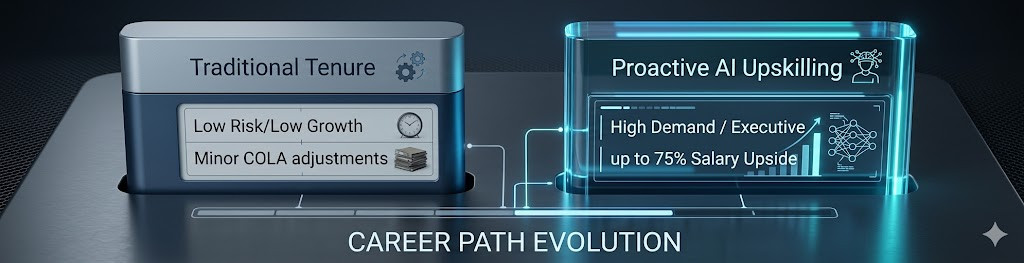
Data shows that while 63% of employees who remained with their current employers managed to secure minor cost-of-living salary increments, those who proactively executed strategic career transitions achieved an average salary increase of 75% with a 9% year-on-year growth trajectory. The message from the market is unambiguous: value is shifting away from tenure and toward technological adaptability.
Three Strategic Imperatives for Professionals and HR Leaders
To remain competitive as a professional—or to retain high-value personnel as an HR leader—organizations and individuals must adapt to this technological integration:
- Transition from Tool-User to Workstream Architect: Knowing how to prompt an AI chatbot is no longer a distinct competitive advantage. Talent demand has shifted toward professionals who can architect entire agentic workflows—mapping out how AI models interact with legacy corporate databases and automated customer touchpoints.
- Leverage Local Upskilling Infrastructure: Professionals should actively tap into reformed institutional frameworks like the newly upgraded "Upskill Hong Kong" program (formerly the ERB), which has systematically removed educational barriers to grant unrestricted access to advanced tech, data analytics, and digital infrastructure training.
- Rebalance the Benefit Architecture: For HR departments struggling to attract high-caliber talent in a tight market where headcount budgets are restricted, compensation packages must be modernized. Forward-thinking firms are rebalancing budgets away from static perks and moving them toward dedicated upskilling allowances, flexible hybrid models, and clear internal pathways for rapid technology-driven promotions.
The New Paradigm
The traditional "job-for-life" corporate expectation in Hong Kong has permanently eroded. The professionals dominating the market today are those using the current period of stability not to rest, but to rebuild their technical skill sets from the ground up.
References
- KPMG International: Hong Kong Employment Outlook Report 2026.
- Hong Kong Labour and Welfare Bureau: Workforce Mobility and Upskilling Reforms.